
Exodus 3:1-4:17 ESV
Exodus 3:1-4:17:
The Burning Bush and Holy Ground
3 1 Now Moses was keeping the flock of his father-in-law, Jethro, the priest of Midian, and he led his flock to the west side of the wilderness and came to Horeb, the mountain of God. 2 And the angel of the Lord appeared to him in a flame of fire out of the midst of a bush. He looked, and behold, the bush was burning, yet it was not consumed. 3 And Moses said, “I will turn aside to see this great sight, why the bush is not burned.” 4 When the Lord saw that he turned aside to see, God called to him out of the bush, “Moses, Moses!” And he said, “Here I am.” 5 Then he said, “Do not come near; take your sandals off your feet, for the place on which you are standing is holy ground.” 6 And he said, “I am the God of your father, the God of Abraham, the God of Isaac, and the God of Jacob.” And Moses hid his face, for he was afraid to look at God.
The Compassionate Plan of Deliverance
7 Then the Lord said, “I have surely seen the affliction of my people who are in Egypt and have heard their cry because of their taskmasters. I know their sufferings, 8 and I have come down to deliver them out of the hand of the Egyptians and to bring them up out of that land to a good and broad land, a land flowing with milk and honey, to the place of the Canaanites, the Hittites, the Amorites, the Perizzites, the Hivites, and the Jebusites. 9 And now, behold, the cry of the people of Israel has come to me, and I have also seen the oppression with which the Egyptians oppress them. 10 Come, I will send you to Pharaoh that you may bring my people, the children of Israel, out of Egypt.”
The First Objection: Moses’ Inadequacy
11 But Moses said to God, “Who am I that I should go to Pharaoh and bring the children of Israel out of Egypt?” 12 He said, “But I will be with you, and this shall be the sign for you, that I have sent you: when you have brought the people out of Egypt, you shall serve God on this mountain.”
The Revelation of the Divine Name
13 Then Moses said to God, “If I come to the people of Israel and say to them, ‘The God of your fathers has sent me to you,’ and they ask me, ‘What is his name?’ what shall I say to them?” 14 God said to Moses, “I am who I am.” And he said, “Say this to the people of Israel: ‘I am has sent me to you.'” 15 God also said to Moses, “Say this to the people of Israel: ‘The Lord, the God of your fathers, the God of Abraham, the God of Isaac, and the God of Jacob, has sent me to you.’ This is my name forever, and thus I am to be remembered throughout all generations. 16 Go and gather the elders of Israel together and say to them, ‘The Lord, the God of your fathers, the God of Abraham, of Isaac, and of Jacob, has appeared to me, saying, “I have observed you and what has been done to you in Egypt, 17 and I promise that I will bring you up out of the affliction of Egypt to the land of the Canaanites, the Hittites, the Amorites, the Perizzites, the Hivites, and the Jebusites, a land flowing with milk and honey.'” 18 And they will listen to your voice, and you and the elders of Israel shall go to the king of Egypt and say to him, ‘The Lord, the God of the Hebrews, has met with us; and now, please let us go a three days’ journey into the wilderness, that we may sacrifice to the Lord our God.’ 19 But I know that the king of Egypt will not let you go unless compelled by a mighty hand. 20 So I will stretch out my hand and strike Egypt with all the wonders that I will do in it; after that he will let you go. 21 And I will give this people favor in the sight of the Egyptians; and when you go, you shall not go empty, 22 but each woman shall ask of her neighbor, and any woman who lives in her house, for silver and gold jewelry, and for clothing. You shall put them on your sons and on your daughters. So you shall plunder the Egyptians.”
The Third Objection: Lack of Credibility
4 1 Then Moses answered, “But behold, they will not believe me or listen to my voice, for they will say, ‘The Lord did not appear to you.'” 2 The Lord said to him, “What is that in your hand?” He said, “A staff.” 3 And he said, “Throw it on the ground.” So he threw it on the ground, and it became a serpent, and Moses ran from it. 4 But the Lord said to Moses, “Put out your hand and catch it by the tail”—so he put out his hand and caught it, and it became a staff in his hand— 5 “that they may believe that the Lord, the God of their fathers, the God of Abraham, the God of Isaac, and the God of Jacob, has appeared to you.” 6 Again, the Lord said to him, “Put your hand inside your cloak.” And he put his hand inside his cloak, and when he took it out, behold, his hand was leprous like snow. 7 Then God said, “Put your hand back inside your cloak.” So he put his hand back inside his cloak, and when he took it out, behold, it was restored like the rest of his flesh. 8 “If they will not believe you,” God said, “or listen to the first sign, they may believe the latter sign. 9 If they will not believe even these two signs or listen to your voice, you shall take some water from the Nile and pour it on the dry ground, and the water that you shall take from the Nile will become blood on the dry ground.”
The Fourth Objection: Lack of Eloquence
10 But Moses said to the Lord, “Oh, my Lord, I am not eloquent, either in the past or since you have spoken to your servant, but I am slow of speech and of tongue.” 11 Then the Lord said to him, “Who has made man’s mouth? Who makes him mute, or deaf, or seeing, or blind? Is it not I, the Lord? 12 Now therefore go, and I will be with your mouth and teach you what you shall speak.”
The Fifth Objection: Flat Refusal
13 But he said, “Oh, my Lord, please send someone else.” 14 Then the anger of the Lord was kindled against Moses and he said, “Is there not Aaron, your brother, the Levite? I know that he can speak well. Behold, he is coming out to meet you, and when he sees you, he will be glad in his heart. 15 You shall speak to him and put the words in his mouth, and I will be with your mouth and with his mouth and will teach you both what to do. 16 He shall speak for you to the people, and he shall be your mouth, and you shall be as God to him. 17 And take in your hand this staff, with which you shall do the signs.”
Introduction
Many believers know what it feels like to carry a burden for something greater. We see needs around us, sense a desire to make a difference, and long to be used by God. Yet there are seasons when our plans fail, doors close, and our dreams seem to disappear into the wilderness.
Moses experienced exactly that.
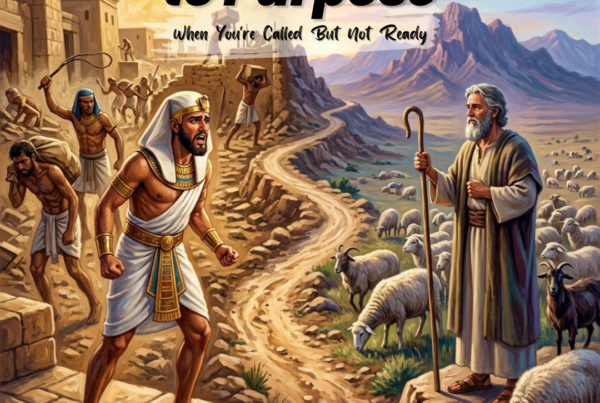
In the first part of this series, we saw that Moses had a genuine burden for his people but acted before he was ready. His attempt to deliver Israel ended in rejection and exile. What appeared to be the end of his story was actually the beginning of God’s preparation. [Read Part 1 Here: From Passion to Purpose: When You’re Called But Not Ready]
Forty years later, Moses was no longer a prince in Egypt. He was a shepherd in Midian. The man who once acted boldly now lived a quiet life in the wilderness.
Then God appeared in a burning bush (Exodus 3:1-4:17), an act that reminds us that God’s purposes are not accomplished merely through human passion. They are fulfilled through God’s commissioning, guidance, and presence.
Body
1. God Reveals Himself Before He Reveals the Assignment
“And the angel of the LORD appeared to him in a flame of fire out of the midst of a bush…” (Exodus 3:2)
Before God spoke about Israel’s deliverance, He first revealed Himself to Moses.
This is significant.
Many people seek direction before seeking God. They want answers before they want relationship. They ask, “What is God’s plan for my life?” before asking, “Who is God?”
But God’s pattern is often the opposite.
Moses first encountered the holiness and majesty of God. The burning bush captured his attention, but God’s presence transformed his understanding.
When Moses approached, God said: “Take your sandals off your feet, for the place on which you are standing is holy ground.” (Exodus 3:5)
Before Moses could represent God to Pharaoh, he needed to know God personally.
The greatest preparation for God’s work is not a position, title, or platform. It is a growing relationship with Him.
2. God Calls Those He Has Prepared
“Come, I will send you to Pharaoh that you may bring my people, the children of Israel, out of Egypt.” (Exodus 3:10)
These words mark a major turning point.
Forty years earlier, Moses assumed he would be Israel’s deliverer. Now God explicitly commissions him.
Notice the difference.
In Exodus 2, Moses acted on his own initiative. But in Exodus 3:1-4:17, Moses is sent by God.
What Moses attempted through human effort, God now commissions through divine authority. Therefore, the years in Midian were not wasted years. God used them to shape Moses’ character, humility, patience, and dependence.
God’s assignments are not given merely because someone has ability. They are entrusted to those whom He has prepared.
3. God Understands Our Fears and Questions
Moses’ response to God’s call is surprisingly hesitant as recorded in Exodus 3:1-4:17. The man who once acted boldly now raises several objections:
- “Who am I?” (Exodus 3:11) – Moses no longer sees himself as a prince or leader. Years in the wilderness had stripped away his self-confidence.
- “What is Your name?” (Exodus 3:13) – Moses wanted assurance that the God who was sending him had authority and power.
- “What if they do not believe me?” (Exodus 4:1) – Moses feared rejection. After all, he had already experienced rejection from his own people.
- “I am not eloquent.” (Exodus 4:10) – Moses focused on his weaknesses.
Many believers can relate to these questions. We may feel inadequate, fear failure, worry about what others will think, or doubt our abilities.
Yet God did not abandon Moses because of his questions. Instead, He patiently answered them.
So, God is not intimidated by our fears. He invites us to bring them before Him.
4. God’s Presence Is the Ultimate Qualification
The most important statement in this entire passage is God’s response to Moses: “But I will be with you.” (Exodus 3:12)
Notice what God did not say. He did not remind Moses of his Egyptian education; He did not point to Moses’ leadership potential; He did not highlight Moses’ past achievements. Instead, God pointed Moses to His presence.
This is the foundation of every God-given assignment.
Moses would stand before Pharaoh because God would be with him. He would lead Israel because God would be with him. And he would face impossible situations because God would be with him.
The same principle remains true for believers today. Our confidence is not ultimately found in our experience, personality, education, resources, or abilities. It is found in the God who calls us and promises to be with us.
5. God Provides What We Need for the Journey
God did not simply give Moses an assignment and leave him to figure everything out. He provided: His presence; His name; Miraculous signs; His authority; and Aaron as a helper and spokesman.
God’s calling always comes with God’s provision.
This does not mean the journey will be easy. Moses would face opposition, disappointment, complaints, and hardship. But he would never face them alone. God who commissioned him, would continue to guide him. And this same God who calls His people today also equips them for what He asks them to do.
Reflection
Exodus 3:1-4:17, therefore, raises the following questions.
- Are you seeking God’s hand more than His face? God’s guidance becomes clearer when our relationship with Him grows deeper.
- Are you trying to create your own opportunities, or are you faithfully waiting for God’s direction? There is great confidence in knowing that God has sent you.
- What fear is holding you back from obeying God today? Have you brought that fear honestly before Him?
Are you focusing more on your limitations than on God’s presence?
Prayer
Father, thank You for Your patience, guidance, and presence as displayed in Exodus 3:1-4:17. Help me to seek You before I seek direction. Teach me to trust Your timing and obey Your calling. When fear and doubt arise, remind me that You are with me. Lead me in Your purpose and give me the faith to follow wherever You send me. In Jesus’ Name, Amen.
Call to Action
Moses’ encounter at the burning bush teaches us several important truths:
- Seek God’s presence before seeking direction.
- God’s timing is as important as God’s purpose.
- Preparation often happens in hidden places.
- God is patient with our fears and questions.
- God’s presence is greater than our limitations.
- God’s calling comes with God’s provision.
Many people spend years asking, “What is God’s purpose for my life?”
Moses’ story in Exodus 3:1-4:17 reminds us that purpose is not merely discovered. It is received through a relationship with God, shaped through preparation, and fulfilled through obedience.
All in all, the burning bush was the game changer. Moses entered that day as a shepherd tending sheep in the wilderness; he left as God’s commissioned servant.
The difference was not that Moses suddenly became more talented or more qualified. It was that God had called him, commissioned him, and promised to be with him.
Perhaps you are in a season of uncertainty. Maybe you are wondering whether God can use you after past failures. Maybe you feel inadequate in the face of the challenges before you.
Take heart from Moses’ story. God specializes in calling imperfect people. He prepares them, guides them, and walks with them.
Your confidence does not rest in your ability to accomplish God’s purpose. It rests in the God who says: “I will be with you.”
Additionally, check out Part 1 of this two-part series and explore How to Read the Bible in One Year or How to Read the Bible (for Beginners)